Defining bilingualism (?)

One summer when I taught a Second Language Acquisition class, I asked my students if they considered themselves to be bilingual. While some did, overwhelmingly, my class of 22 students did not. I further asked those students how they would rate their proficiency in their second language, on a scale of 1-10. Most of them assessed their proficiency as being quite high, i.e., about a 7 or higher on a scale of 1-10. So, how could such a group of people – who are apparently highly proficient in their second language – still not consider themselves as bilingual?
Many of them had also learned their second language later in life. In other words, they did not necessarily grow up speaking two languages. While my proficiency measure (scale of 1-10) and “thought experiment” in class was imperfect, I think it is still representative of how society tries to view bilingualism as categorical: you’re either bilingual, or you’re not. The definition of bilingualism is even more rigid, societally speaking: to be bilingual, you must have been raised speaking two or more languages (or so it seems). Other attempts to “quantify” or “define” bilingualism may be, e.g., “you should be balanced in both languages”, or “you should be ‘absolutely’ fluent in both languages” (this, of course, begs another one of my favorite questions, namely ‘how does one define fluency’. Perhaps you’ll even notice me using the term ‘highly proficient’ over ‘fluent’ here).
Realistically, bilingualism is a lot less categorical than it is a continuum of experiences. As it turns out, it is really quite difficult to come up with a hard and fast definition of bilingualism, and therefore it is further difficult to neatly categorize someone as bilingual vs. monolingual! In fact, even when conducting research with populations who predominantly speak only one language, researchers still overwhelmingly use the term “functional monolingual” over just “monolingual”. This is because even passive language exposure can tune our sensitivity to second or more languages and can impact us on a cognitive (mind) and neural (brain) level!
Some factors that shape the bilingual experience are, for example, the age at which we learn or acquire both languages, how often we are exposed to and use both of our languages, our proficiency in both of our languages, whether or not we’ve lost/forgotten languages that we once acquired (that can happen?), and even (ir)regular exposure to languages that we don’t speak or in which we aren’t proficient.
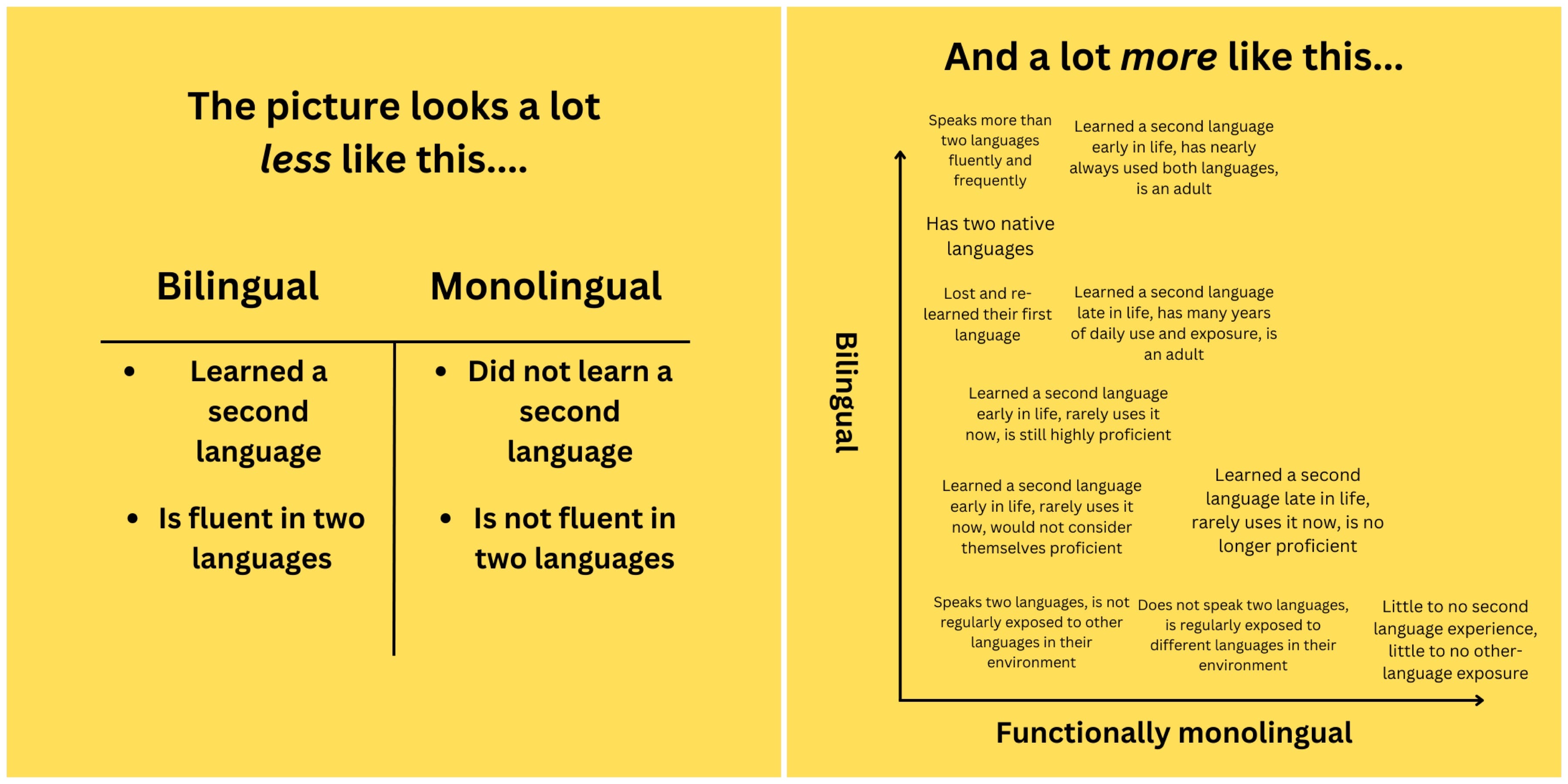
But why does this matter? As we’ll further explore in later posts, “being bilingual” can impact our mind and our brain – for example, some studies find that bilingualism may impact how we control our attention, and it can also, e.g., stave off symptoms of dementia. However, to study how bilingualism impacts our mind and brain, it is also worthwhile and imperative to consider all of the other factors that comprise the bilingual experience. For example, even more than we might consider how “bilingualism” impacts, e.g., our ability to control our attention (attentional control), we might ask “how does the age at which one acquired both of their languages impact attentional control? (Or, rephrased for fellow psycho/neurolinguists out there who might be reading this, how do factors like AoA, proficiency, exposure, etc. modulate cognitive and neural outcomes.)
Moreover, bilingualism has made more than one appearance in popular media and journalistic outlets, but often with sensationalized or flashy headlines. Until very recently (e.g., within the last two decades or so), even research viewed bilingualism as more of a categorical variable, leaving entire groups of people out of the research population (as we will explore in future posts)! (E.g., adult learners of a second language, people who lost their first language and became dominant in their second language, etc.)